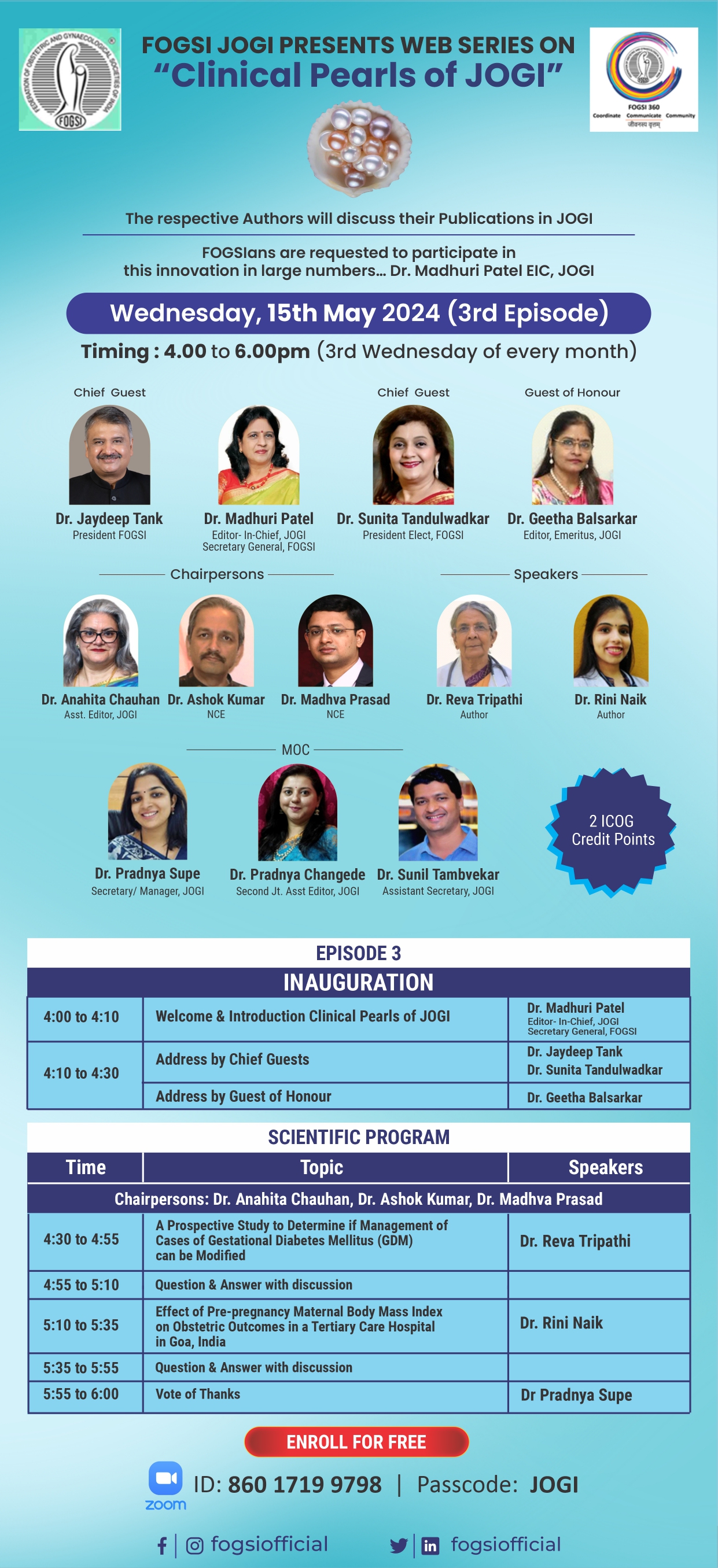


Anahita Chauhan is former Professor and Unit Head at Seth G.S. Medical College and K.E.M. Hospital, Mumbai, andHonorary Consultant at Saifee Hospital Mumbai. She serves as the Secretary and Manager of the Journal of Obstetrics andGynecology of India and as Librarian (Office Bearer) of Mumbai Obstetric and Gynecology Society
Purpose: The objective was to observe the characteristicsamong pregnant patients with a diagnosedhemoglobinopathy and to study the obstetric and medicalmorbidity patterns during the antenatal and the perinatalperiods in this group of patients.
Methods: A prospective observational study was conductedin a tertiary care center.
Results: Sixty patients were studied in 11 months. Primi-gravidae (43.3%) formed the highest percentage ofpatients.bThalassemia trait was the most commonhemoglobinopathy, seen in 81.66% of study subjects. Thehemoglobin value ranged from 5.7 to 13.0, with an averageof 9.2 g/dl. Thyroid problems were the most commonassociated medical disorder. Though IUGR and placentaprevia were common, there were no major obstetric prob-lems. There were 57 live births and 1 fresh stillbirth. Twopatients had spontaneous abortion for which uterine curettage was done. LSCS was the most common obstetricoutcome. Patients with sickle-cell disease required moreblood transfusion than those with beta-thalassemia trait.There were 2 maternal mortalities, and both the patientswere the diagnosed cases of sickle-cell disease.
Conclusions: While the perinatal outcomes among womenwith sickle-cell disease are poor, the outcomes in pregnantpatients with beta-thalassemia trait were not a cause ofmajor concern.
Keywords : Hemoglobinopathy, Beta-thalassemia, Pregnancy outcomes, Perinatal outcomes
Hemoglobinopathies are a group of disorders which affect the hemoglobin molecule in its structure, function or pro-duction. The morbidity among females with hemoglobi-nopathies during pregnancy can range from asymptomatic investigational abnormality to mortality. Recent advancesin the treatment of these disorders have increased the lifeexpectancy and quality of life of affected patients. It is increasingly being recognized first time during pregnancy.It is more common than ever before for women withhemoglobinopathies to reach childbearing age and to undergo pregnancy. While a lot of emphasis has been puton the prevention, the focus of this study was to observe thematernal and neonatal outcomes among a cohort of pregnancies with an already-diagnosed hemoglobinopathy. This has previously not been studied or reported in much detail.
In this context, the study was undertaken with the objectives as follows.
A prospective observational study was conducted in thedepartment of gynecology and obstetrics in a tertiary carereferral hospital after institutional ethics approval. Pregnantwomen attending the department for antenatal follow-upand delivery were checked for an abnormal hemoglobinelectrophoresis report. Those with a diagnosedhemoglobinopathy were identified and included in thestudy. All hemoglobinopathies were included, including‘traits.’ Only those women who delivered or underwentcompletion of pregnancy at the institute were included.Patients were included irrespective of parity status andregistration status. Medical termination of pregnancy onrequest was excluded from the study. It is to be emphasizedthat hemoglobin electrophoresis was not advised for thepurpose of this study.
The sample size was calculated with the formula, n=t2x p(1-p) m2, where N=required sample size, t=confi-dence level at 95% (standard value of 1.96) p=estimatedprevalence of the problem in the area=4.0% [1],M=margin of error (standard value of 0.05%). The valueworked out to be 59. For mathematical convenience, thechosen sample size was 60.
At the time of admission for delivery, physical exami-nation and relevant investigations were all documented.The patients were followed up till their discharge from thepostnatal ward. The parameters which were studied are asfollows. Details regarding whether antenatal geneticcounseling and invasive attempts (chorionic villus sam-pling (CVS)) to diagnose problems in the fetus was done,were noted. All complications during the antenatal–peri-natal–postnatal periods were noted. Requirement of trans-fusion of blood or blood products in the antenatal–perinatalperiods was noted. Obstetric outcomes such as length ofpregnancy, mode of delivery, details regarding anyabnormal course in the labor were noted. Neonatal out-comes such as birth weight, Apgar score, neonatal inten-sive care unit (NICU) admission were noted. Anyabnormalities like neonatal jaundice, malformations,hydrops fetalis and neonatal death, if present were noted.The details were compiled and statistical methods per-formed. During the hospital stay, the patients wereexplained in detail about the nature of their condition andcounseled regarding further follow-up.
Statistical Calculations: Being an observational study,simple statistical calculations using mean and percentageswere performed.
Sixty patients with hemoglobinopathies were included inthe study, and they were identified in duration of11 months. During this study period, there were 6972deliveries in the hospital. As shown in Fig.1,bthalassemiatrait was the most common hemoglobinopathy identified,which was seen in 49 patients (81.66%). Sickle-cell diseaseformed the second most common hemoglobinopathy,found in 8 patients (13.3%), while 3 patients had othertypes (one each of HbD, HbE and Hb beta thal/HbFcombination).
The highest number of patients belonged to the agegroup of 26–30 (36.6%), followed closely by the age group of 21–25 (35%). Only one patient was above 36. Only onepatient in the study group was unmarried, and two coupleshad second-degree consanguinity. Rest all were noncon-sanguineous marriages. Primigravidae (43.3%) formed thehighest percentage of patients. Multigravidae with previousvaginal delivery were more common than multigravidaewith previous cesarean section. A smaller percentage hadprevious abortion(s) (16.6%).

63.3% of the patients had registered with the hospital onoutpatient basis, while the rest of the patients were referredat the time of delivery to the hospital. Thirty-three out ofthe 60 patients (55.55%) had at least 3 antenatal outpatientdepartment (OPD) visits, suggesting less-than-optimalcompliance to regular antenatal follow-up. A majority ofthe patients (30%) were referred to the institution at thetime of delivery, after 30 weeks of gestation. This wasclosely followed by 28.33% of patients having registered inthe OPD between 21 and 30 weeks of gestation. A majorityof the patients (70%) delivered between 37 and 40 weeksof gestation. Fifteen percent of the patients were deliveredpostdated, while 11% were preterm deliveries. A total of 9patients required induction of labor. With respect to thetime of detection of hemoglobinopathy, 60% of the patientswere detected to have a hemoglobinopathy during thecurrent pregnancy.
The hemoglobin value ranged from 5.7 g/dl to 13.0 g/dl,with an average of 9.2 g/dl and a standard deviation of1.33. With respect to the husband’s electrophoresis report,40% of the husbands did not have an electrophoresis report.Out of the remaining 60% who got the report done, a smallnumber 5 (8.33%) had an abnormal report. All the 5 hadbthalassemia trait in the hemoglobinopathy detected. Inother words, 13% of husbands who underwent testing hadan abnormal hemoglobin electrophoresis report. Amongthose patients whose husbands who had an electrophoresisreport, 80% were following up in the antenatal OPD.
While analyzing the number of previous child affectedby hemoglobinopathies, only 2 patients (3.33%) had aprevious child diagnosed with a hemoglobinopathy.
11.66% (7 out of 60) of patients had undergone aninvasive test for prenatal diagnosis of fetal affliction.Among these, 2 patients had a history of a previous childbeing affected by the disease. All the 7 tests were CVSdone in late first trimester–early second trimester; and in allof these, the fetus was not affected by the disease andpregnancy was continued successfully.
Requirement of blood transfusion: Among those withbeta-thalassemia trait, 8 patients required blood transfusionin the antepartum period, while 11 patients requiredtransfusion in the peripartum period. Two patients requiredblood transfusion both antepartum and peripartum periods.Out of 8 patients with sickle-cell disease, 2 required bloodtransfusion in the antenatal period and 3 required in theperipartum period. One patient required blood transfusionin both antenatal and peripartum periods.
Associated medical high risks: As shown in the Table1,thyroid problems were the most common associated med-ical disorder.
Surgical problems: One patient (with HIV positive sta-tus) developed a gluteal abscess which required incisionand drainage. One patient had nephrolithiasis whichworsened and required percutaneous nephrolithotomy. Sixpatients had prior history of appendicectomy. Threepatients with sickle-cell disease had avascular necrosis ofthe hip and were yet to undergo any surgical management.
Antenatal obstetric problems: As shown in Table2,there were no major obstetric problems. Intrauterinegrowth restriction and placenta previa were common.
Obstetric outcomes: As shown in Fig.2, there were 57live births and 1 fresh stillbirth. Two patients had sponta-neous abortion for which uterine curettage was done. Asshown in Fig.1, lower segment cesarean section (LSCS)was the most common obstetric outcome, which onstituted 50% of all the patients studied. Thirty-ninepercent of the patients delivered by full-term vaginaldeliveries, while 2 were preterm vaginal deliveries. Themost common indication of LSCS in the present study wasfetal distress (33.3%). One patient required B-lynchsuturing in view of atonic postpartum hemorrhage.


Maternal mortality: Among the 60 patients studied,there were 2 maternal mortalities. Both the patients werediagnosed cases of sickle-cell disease.
The first was a 32-year-old G4A3 referred at 32 weeksof gestation with bad obstetric history with sickle-cellanemia with IUGR with previous 1 LSCS, with hypothy-roidism, severe anemia and severe preeclampsia. Two unitsof blood was given for the correction of anemia. Evaluationof IUGR revealed severe changes in Doppler flow; aspatient refused consent for vaginal birth, LSCS wasperformed. However, there was sudden fetal distress justprior to LSCS and she delivered a fresh stillbirth of1.365 kg. Patient was stable during initial postoperativeperiod, but developed fever, urinary tract infection andsurgical site infection on day 7 of LSCS, after which sheshowed signs of sepsis and multiorgan failure. She deteri-orated progressively despite intensive unit care and expiredon day 14 of LSCS due to sepsis with acute respiratorydistress syndrome.
The second patient, a 22-year-old primigravida with38 weeks of gestation, was referred for acute onset ofbreathlessness. Prior to this episode, pregnancy had beenuneventful. Patient was admitted in active labor anddelivered a healthy male child of 2.1 kg, following whichshe was transferred to the intensive care unit for furthercare. The patient developed severe breathlessness, whichdid not improve despite medications, and required intuba-tion. She succumbed on day 2 of delivery.
Neonatal outcomes: There were 51.5% females and48.5% males. 57 were live births, while only one was afresh stillbirth. There were no early neonatal deaths. Thebirth weights ranged between 1.365 kg and 3.7 kg, with anaverage weight of 2.79 kg and a standard deviation of0.488. One baby had persistent hyperbilirubinemia needingphototherapy, one was transferred to NICU for transienttachypnea and one had large mesenteric cyst managedconservatively. One baby was transferred for adoption.
Survival in hemoglobinopathies has improved, is becomingincreasingly safe and forms the basis of this study [2]. Theprevalence of abnormal hemoglobin in the West Bengalstate of India is approximately 12% as reported in the largeprospective study over 10 years by Mondal et al. [3]. Themost common abnormality was beta-thalassemia traitwhich was found in 4.6%. This was followed by HbE trait,beta-thalassemia major and other abnormal hemoglobintypes. A single-center study in central India which under-took population screening estimated the prevalence of beta-thalassemia carrier state to be around 2.78% [4]. A slightlyhigher prevalence of abnormal hemoglobin types may befound in rural areas [5]. The prevalence reported by Colahet al. in western India where this study was conducted is4.0% [1]. In our study, only those with an already-availableabnormal hemoglobin electrophoresis report were inclu-ded, and no hemoglobin electrophoresis was advised forthis study purpose. We identified 60 patients in around11 months when the corresponding deliveries were 6972,which gives a rate of 0.86%. This is not comparable withpopulation statistics because a heterogeneous population isreferred to the hospital for management of various problems. The mean hemoglobin in the study was 9.2 g/dl.In a 20-year experience with pregnancies with beta-tha-lassemia intermediate in a Greek cohort of patients,Voskaridou et al. estimated the average hemoglobin was8.4 g/dl [6]. The lowest hemoglobin recorded in the presentstudy was 5.5 g/dl. This is similar to the findings of a studyconducted by Nassar et al. who studied beta-thalassemiaintermedia at two tertiary care centers in Europe, and thelowest hemoglobin of 5.2 g/dl [7]. Vuthiwong et al. studiedthe attitudes of husbands of patients with abnormalscreening in Thailand and demonstrated that when thefemale has an abnormal test, the husbands have a favorableattitude toward self-testing. Similarly, 63% husbands of themothers in this group of patients underwent testing to lookfor a carrier status [8]. Patients who were antenatal regis-tered and had regular follow-up, along with their spouses,were more likely to have undergone screening for hemo-globinopathies. This is in agreement with the study con-ducted by El-Beshlawy et al. In their study conductedregarding attitudes toward prenatal diagnosis of hemoglo-binopathies, it was demonstrated that appropriate coun-seling improves acceptance for screening methods amongat-risk patients and their relatives [9].
Chorionic villus sampling (CVS) is a safe procedure forprenatal diagnosis of hemoglobinopathies. Asnafi et al.have described a large series of patients undergoing CVSand confirmed the same [10]. Seven patients in our studyunderwent CVS, and there were no procedure-relatedcomplications; pregnancy continued successfully. 19.5% ofpatients were not transfused at all or they had been trans-fused only once during pregnancy. Similar results, i.e.,26.5% of patients not transfused at all or had been trans-fused only once during gestation, were reported byVoskaridou et al. [6]. However, Nassar et al. reported that79.5% of pregnancies withbthalassemia intermediarequired blood transfusion [7]. Most patients with sickle-cell disease required blood transfusion, and it was morewhen compared to the beta-thalassemia trait. This higherrequirement of blood transfusion among sickle-cell diseaseis supported by the study by Daigavne et al. also [11].
Thyroid abnormalities were the most common associ-ated medical condition in our patients. Other major medicalcomplications were not observed. This is supported by astudy by Tsatsalas, who has described the pregnancies withbeta-thalassemia carriers as ‘an uneventful journey’ [12].Similar results have been described by Charoenboon et al.[13]. In the present study, the prevalence of preeclampsiawas 5% while that of GDM was 1.66%. This is in agree-ment with the studies conducted by Yordanova et al. andHanprasertpong et al. Both had concluded that the rate ofthese obstetric conditions in patients with hemoglobino-pathies is comparable to that of the normal population[14,15]. Most of the patients in our study carried on till full-term pregnancy. Our group of patients had very smallrate of preterm labor and small-for-gestational age. In theirrespective studies, Voskaridou et al., Yordanova et al. andKemthong et al. have all reported that the rate of obstetriccomplications in hemoglobinopathies is of negligible con-cern [6,14,16].
LSCS was the most common mode of delivery. Yor-danova et al. have also recently reported that cases withbthalassemia minor have significantly higher prevalence ofcesarean section delivery [14]. There were two maternalmortalities in our group of 60 patients, of which both weresickle-cell disease. In other developing countries also,sickle-cell disease causes significant morbidity and mor-tality [17,18].
Higher risk of adverse pregnancy outcomes and need forspecialized care in those with sickle-cell disease has beenemphasized in community studies also [19].
To conclude, beta-thalassemia trait was the most com-mon hemoglobinopathy affecting pregnancy. The obstetricoutcomes in the group of patients with beta-thalassemiatrait were not a cause of major concern. Sickle-cell anemiathough lower in incidence causes significant maternalmorbidity. There were no major neonatal problems.
Acknowledgements: The corresponding author would like toacknowledge Late Dr Jayant S Rege for his initial contribution towardthe study.
Conflict of interest: Anahita Chauhan and Madhva Prasad declarethat they have no conflict of interest.
Ethical Statements: All procedures followed were in accordancewith the ethical standards of the responsible committee on humanexperimentation (institutional and national) and with the 1975 Dec-laration of Helsinki, as revised in 2008.
Ethical Approval: Institutional ethics committee approval wasobtained. Informed consents were obtained from the patients in thestudy.
Human and Animal Rights: This article does not contain any studyinvolving animal subjects.