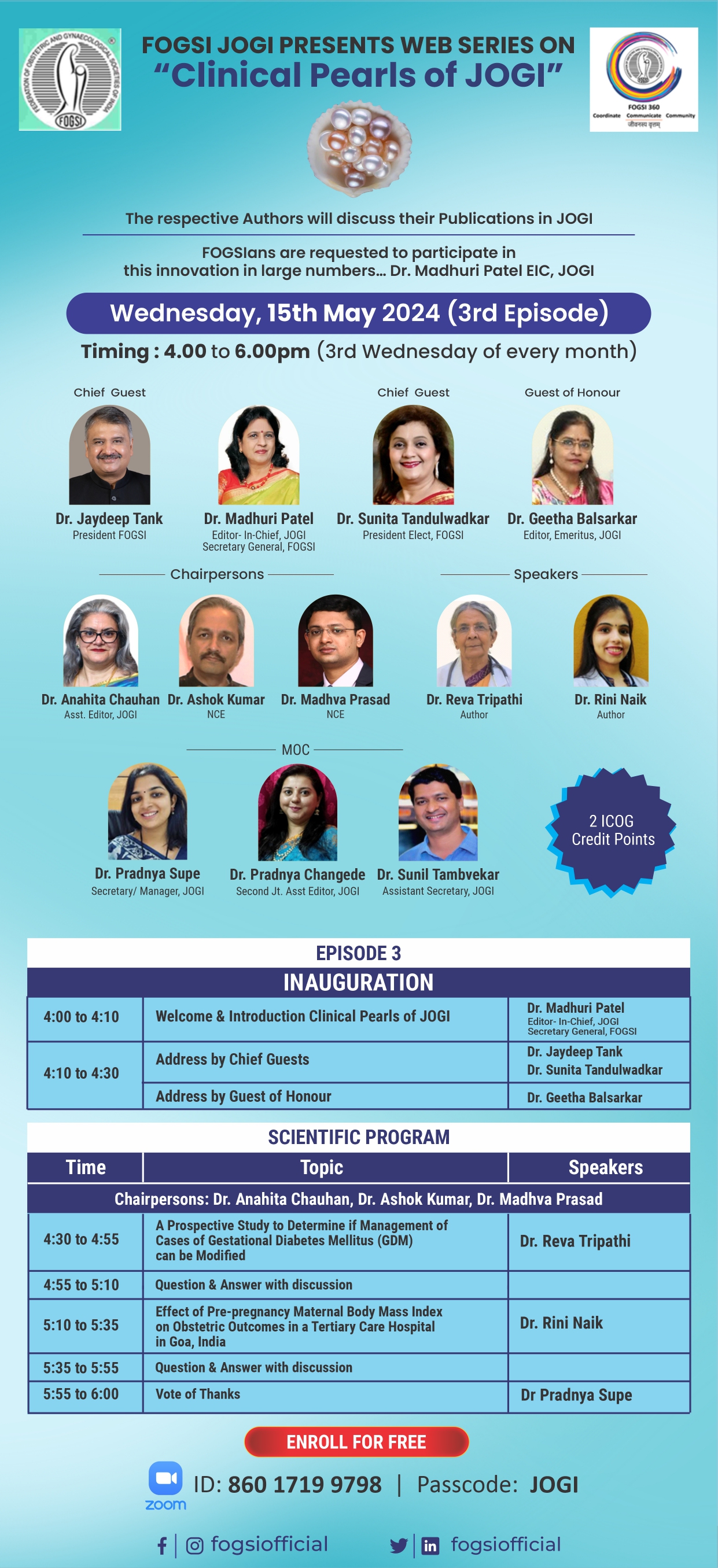
Reva Tripathi Dr. Reva Tripathi is HOD and Professor in Obs and Gynae department at Hamdard Institute of Medical Sciences and Research, New Delhi. Previously, she has served as Head and Professor of Obs and Gynae department at Maulana Azad Medical College and associated Lok Nayak Hospital, New Delhi. She is a keen academician. Her areas of interest are high-risk pregnancy and preventive oncology. She is a recipient of many awards and grants. Reva Tripathi’s research interests reflect in wide range of publications in various national and international journals. Her international experience includes various programs and participation in different countries for diverse fields of study.
Background
To study maternal–fetal outcomes in patients of GDM diagnosed by International Association of Diabetes and Pregnancy Study Groups (IADPSG) criteria but subsequently using a twenty-four-hour seven-value sugar profile to evaluate patients before instituting management. Methods This prospective observational study was conducted at a tertiary hospital in New Delhi, India, over a period of one year. During this period, women diagnosed as GDM between 24 and 28 weeks of gestation using IADPSG criteria underwent seven-value sugar profile in twenty-four hours before initiating any therapy. Those with normal profile were kept on observation only, whereas others were managed by Medical Nutrition Therapy (MNT) with or without pharmacotherapy as required to maintain euglycemia. Maternal and fetal outcomes were documented and analysed to detect differences between the groups.
Results
Out of 2279 pregnant women, 201 (8.8%) were diagnosed as GDM. The twenty-four-hour seven-value sugar profile was normal in 78 (38.8%) patients, who were managed only by close observation. Treatment was given to other patients; 93 (46.2%) patients were managed with MNT only, whereas pharmacotherapy by way of metformin was added to 22 (10.9%) patients and 8 (3.9%) patients required insulin. Differences in maternal–fetal outcomes between the treated and untreated groups were not found to be statistically significant.
Conclusions
The policy of evaluating patients with twenty-four-hour seven-value sugar profile after an abnormal Oral Glucose Tolerance Test eliminated over one-third women from receiving treatment and interventions for GDM without compromising maternal–fetal outcomes.
Keywords : GDM · Twenty-four-hour seven-value sugar profile · IADPSG · Maternal–fetal outcomes
Gestational Diabetes Mellitus (GDM) is gradually assuming epic proportions and is of special significance because it affects both maternal and fetal wellbeing, impacting both short- and long-term outcomes by way of increased risk of gestational hypertension, pre-eclampsia, caesarean section and type 2 diabetes in mothers and macrosomia, neonatal hypoglycaemia and type 2 diabetes later in life for the baby [1–3]. The currently followed criteria of International Association of Diabetes and Pregnancy Study Groups (IADPSG) have had a major impact on increasing prevalence of GDM, [4] which leads to increased antenatal surveillance, ultrasonographic examinations, inductions, caesarean deliveries, etc., leading to a significant increase in healthcare costs. This is especially of concern for low and middle-income countries, which contribute to 90% cases of GDM [5] but paradoxically are the very countries that need to optimise healthcare costs while still striving to achieve the objectives of the Sustainable Development Goals.
The IADPSG glucose cut-off values were derived after the Hyperglycemia and Adverse Pregnancy Outcome (HAPO) study, where glucose values at which odds for birth weight, cord C-Peptide and body weight reached 1.75 times the mean [1]. Important obstetric clinical outcomes like need for induction of labour, caesarean section rate, hypertensive disorders of pregnancy and perinatal outcomes like neonatal hypoglycaemia or admission to neonatal intensive care units were not considered.
It had been observed as part of a previous study on GDM [6] that patients get labelled as GDM using IADPSG cut–offs, though derangement of Oral Glucose Tolerance Test (OGTT) is only marginal on some occasions. It was therefore decided to investigate whether all patients with a deranged OGTT need to be treated. The requirement of this was felt keeping in mind poor resource availability in our settings.
As per standard management of GDM, blood sugar monitoring is done by glucometer. The testing is usually done fasting and post-meal though the number of tests performed and frequency of testing are debatable. The patients requiring insulin are advised a maximum of seven tests during twenty-four hours. As this testing is recommended in the worst-case scenario, the authors decided to perform a twenty-four-hour seven-value sugar profile before initiation of treatment for the purpose of this study. This modality of testing was used as a modification of standard treatment in a research setting, and it was therefore felt that it may be better to err on the side of doing too much rather than too little.
This prospective observational pilot study was conducted over a one-year period. Ethical clearance was obtained from Institutional ethical committee. The patients were recruited from amongst those attending antenatal clinic of our hospital. They were subjected to 75 g OGTT between 24 and 28 weeks of gestation. Those patients whose blood sugar (BS) values on OGTT exceeded the cut-offs as per recommendation of IADPSG guidelines were diagnosed as GDM (i.e. fasting ≥ 92 mg/dl, 1 h ≥ 180 mg/dl, 2 h ≥ 153 mg/dl) [7]. Patients whose OGTT values at fasting and two hours exceeded 126 mg/dl and 200 mg/dl, respectively, were excluded as they fell into the category of overt diabetes
These women who had abnormal OGTT and had been diagnosed as GDM were then admitted to hospital for twenty-four hours. During this period, they were subjected to a seven-value glucose profile documentation including fasting, pre- and post-meals (breakfast, lunch and dinner) and 2 am by glucometer using capillary blood samples.
Patients with fasting and 2 h post-prandial blood glucose values < 95 mg/dl and < 120 mg/dl, respectively, were considered euglycemic as per recommendation of American Diabetes Association (ADA) and the American College of Obstetricians and Gynaecologists (ACOG). Hospitalisation was required to avoid this extensive testing at home due to logistical reasons. This seven-value glucose profile documentation strategy is similar to the manner in which patients of GDM requiring pharmacotherapy are monitored [8]. During hospitalisation, no dietary modification was done.
On the basis of the 24-hour seven glucose value profile, patients were divided into four groups indicating the intervention utilised. These were (1) group 1: patients with normal glucose profile who were not started on any treatment including no dietary modification; (2) group 2: medical nutrition therapy (MNT) only; (3) group 3: oral hypoglycaemic agents viz. Metformin; and (4) group 4: Insulin. In both groups 3 and 4, pharmacotherapy was used in addition to MNT. Patients were initially put on diet modification by hospital dietician for two weeks, and pharmacotherapy was added later if required as manifested by suboptimal blood glucose values. Treatment category was revised based on the BS profile. The Category allocation at the time of delivery was used for analysis.
Monitoring of patients in no treatment group and those on MNT (Groups 1 and 2) was done by evaluation of fasting and postprandial blood glucose values fortnightly, whereas patients of groups 3 and 4 on pharmacotherapy were monitored more intensively by multiple capillary glucose evaluation (at least four) done at least twice weekly. This was done at home by glucometer after appropriate training, i.e. self-monitoring of blood glucose (SMBG). The post-meal evaluations were done after two hours of major meal intake. The target was to achieve fasting and 2 h post-prandial blood glucose values < 95 mg/dl and < 120 mg/dl, respectively. In addition to monitoring of sugar values, patients were seen for clinical evaluation every two to three weeks in the antenatal clinic. Most patients had at least one sonographic examination between 34 and 36 weeks period of gestation for documentation of biometry, growth and liquor.
All patients were followed till delivery, and their maternal– fetal outcomes were studied. The maternal outcome parameters noted were polyhydramnios, pregnancy induced hypertension (PIH), induction of labour (IOL) and caesarean section/operative vaginal delivery, whereas fetal parameters recorded were birth weight, macrosomia, fetal growth restriction (FGR), Apgar score at birth, admission to neonatal intensive care unit (NICU) and occurrence of any other neonatal morbidity.
The essence of the study was to mimic usual GDM management in three conventional groups of MNT, OHA and insulin but additionally to follow-up one group without intervention and to record outcome differences if any.For statistical comparison of Treatment versus Non-Treatment group, Z test of proportion of two group method was used with 95% CI (Fig. 1).

Out of the 2279 deliveries during this period at the hospital, 201 (8.8%) were diagnosed as GDM based on IADPSG criteria. Demographic data showed that the average age at diagnosis was 27.6 years and 31.4% women were primigravida. According to the twenty-four-hour seven-value profile, 78 (38.8%) patients were labelled as Group 1 and no therapeutic management was initiated. Of the remaining 123 patients, 93 (46.2%) were labelled as group 2 who were treated by MNT alone. Group 3 and Group 4 had 22 (10.9%) and 8 (3.9%) patients, who were given metformin and Insulin, respectively, in addition to MNT.
The demographic characteristics are presented in Table 1. The data showing period of gestation at the time of delivery are shown in Table 2. After delivery, the mean weight of the babies and Apgar score are tabulated in Table 3. The maternal– fetal outcomes are summarised in Table 4.


Table 4 shows that there were no major statistically significant differences in various maternal and fetal outcome parameters between the treated and untreated groups. Significantly, no patient who was put in category of “no treatment” required to be shifted to a therapeutic category and no adverse perinatal outcome occurred. Therefore, these 78 (38.8%) patients could be managed as routine antenatal patients without labelling them as GDM and increasing unnecessary intervention.
GDM is a clinical problem associated with both maternal and fetal complications. In the last decade, number of GDM cases have risen exponentially, primarily due to the newly implemented IADPSG diagnostic criteria which are based on the HAPO study [9–11].The diagnosis of GDM has led to increased interventions both antenatal and intra-partum. A need was therefore felt by the authors to evaluate whether all diagnosed GDM patients actually required treatment. They have questioned conventional management strategy and have attempted to modify it to rationalise number of cases in whom extra care is really warranted.
India has traditionally been a country notorious for low birth weight babies, so it is paradoxical that now the pendulum has swung to the other extreme where hyperglycaemia and its consequence of C-peptide linked, large for gestational age babies is in the forefront owing to the larger number of women having GDM. Undoubtedly, there has been an increase in the average birth weight of the Indian new born [12], but it can barely be considered in the realm of abnormality or macrosomia. The metabolic concern has rather been the low birth weight new born with rapid weight gain post-natally which has been associated with metabolic syndrome later [13]. No Indian study could be located depicting the problem of cord C-peptide levels in the general population or in infants born to mothers with GDM.
Euglycemia is the cornerstone of management of GDM as negative outcomes are directly attributable to hyperglycemia. This was the rationale behind performing twentyfour- hour seven-value glucose profile prior to instituting therapeutic intervention. Once a normal profile has been documented and euglycemia ensured, treatment can be withheld. Further, if these patients are treated as ‘normal’, the subsequent battery of tests for monitoring a “diabetic” patient in the antenatal period may be considered redundant. The clinical outcome data support this management methodology as no major / statistically significant differences were seen between those patients managed by this method versus those who were managed by standard therapeutic interventions of MNT or pharmacotherapy as per the data presented earlier.
The fact that the number of common clinical problems in GDM cases managed without treatment did not increase shows that hyperglycemia was not a problem. In fact, the increased number of inductions in the treatment group is a pointer to the increased interventions performed in GDM cases. The small proportion of patients requiring pharmacological management (Table 1) also reveals that most patients with deranged OGTT are likely to be only mildly diabetic.
This strategy led to the final prevalence of GDM in this population being reduced from the original figure of 8.8% to 6.11% without impacting maternal or perinatal outcomes. This different and lower prevalence rate would have a large impact on health care costs and policy and would merit ratification by a larger study. However, if as many as 38.8% patients can be managed simply without compromising perinatal outcomes, this is likely to result in a huge benefit of optimisation of resource utilisation.
A valid question would be as to why a patient with an earlier reported abnormal OGTT, later turns out to be euglycemic. The large number of patients with abnormal OGTT who manifest only with a high fasting blood sugar value may be peculiar to Indian ethnicity. This may be explained by the thrifty gene hypothesis applicable to a chronically undernourished people [14]. The stress of the first test may provoke a transient hyperglycemia that is not replicated later which results in a normal sugar profile subsequently. It is therefore further suggested that in Indian settings, where fasting hyperglycemia is an important contributor to abnormal OGTT, the Diabetes In Pregnancy Study Group of India (DIPSI) criteria may not be very reliable because it does not take into account the fasting values [6, 15].
Another possibility postulated for occurrence of initial abnormal OGTT was that there is poor reproducibility of the OGTT which has been documented elsewhere, albeit in another setting [16]. As it is not practically feasible to do repeat testing, it is unlikely to be done in the pregnant woman. However, it is not scientifically incorrect to withhold interventions in a woman who is euglycemic. These patients were also monitored clinically for the suspicion of macrosomia or hydramnios which are likely to occur if there was hyperglycemia which had not been taken cognisance of. However, the clinical outcomes showed no such evidence.
Another potential possible explanation could be the issue of laboratory inaccuracies which may be a major concern regarding cut-off values of OGTT. Even the laboratories following external quality assurance programmes would label values within one standard deviation as normal. In case of glucose values, a coefficient of error of 3% is well accepted [17] and therefore most biochemistry laboratories would consider 3% margin of error within requirements of an accurate report. Additionally, External Quality Assurance System (EQAS) criteria also allow this margin of error [17–19]. However, as per the HAPO based recommendations of IADPSG, specific cut offs are given and implemented. When this is coupled with only one abnormal value required to diagnose GDM, the escalation of numbers is a foregone conclusion and this modification of management is an attempt to rationalise the number of cases that require interventions.
an accurate report. Additionally, External Quality Assurance System (EQAS) criteria also allow this margin of error [17–19]. However, as per the HAPO based recommendations of IADPSG, specific cut offs are given and implemented. When this is coupled with only one abnormal value required to diagnose GDM, the escalation of numbers is a foregone conclusion and this modification of management is an attempt to rationalise the number of cases that require interventions.
Is the problem of a direct link between cord C-peptide and hyperglycemia, which was the basis of the outcome of the HAPO study and thus the basis for calculation of IADPSG cut offs, an oversimplification of a cause and effect analysis? We would like to suggest that there may be a variety of additional / other factors, possibly epigenetic, that may be playing an important role but are unknown today. The gender differences of cord C-peptide have been documented earlier [20], whereas another study on weight gain in obese pregnant women also stated that despite excluding GDM cases, cord C-peptide and other fetal metabolic parameters were affected [21]. This may suggest that there is an interplay of multiple factors affecting metabolic changes in a neonate. This could therefore lead to questioning the importance of cord C-peptide values which was one criterion for the basis of HAPO outcomes and subsequent recommendations. Also, one may need to consider whether the response in the Indian setting is similar to that seen in other populations as Indians were not included in the original HAPO study.
It may therefore be summarised that institution of a strategy that documents euglycemia before initiating treatment, despite patients having had an abnormal OGTT, may be useful in differentiating those cases of GDM who really need interventions from those in whom routine antenatal care is acceptable. This approach would need validation from a Randomised Controlled Trial with adequate sample size before it can be considered for general use outside a research setting. Till such time, good clinical sense should be used as an adjunct to guide management in patients having minimally deranged blood sugar values.
Strength and Limitations
This study is a novel approach to management of GDM. The limitations of the study are its small numbers and lack of randomisation. Other possible issues could be lack of uniformity in types of glucometers used and lack of data on dietary patterns in patients before testing. Also, only short-term outcomes have been analysed and the long-term problems of childhood obesity and later development of type 2 Diabetes Mellitus are not known. However, it is possible that environmental and dietary influences later in life causing epigenetic changes may have a larger role to play in this.
Conflict of interest The authors have no conflicts of interests to declare.
Ethical Approval The study has been approved by the Institutional Ethical Committee.
Informed Consent Informed consent was obtained from the individuals.