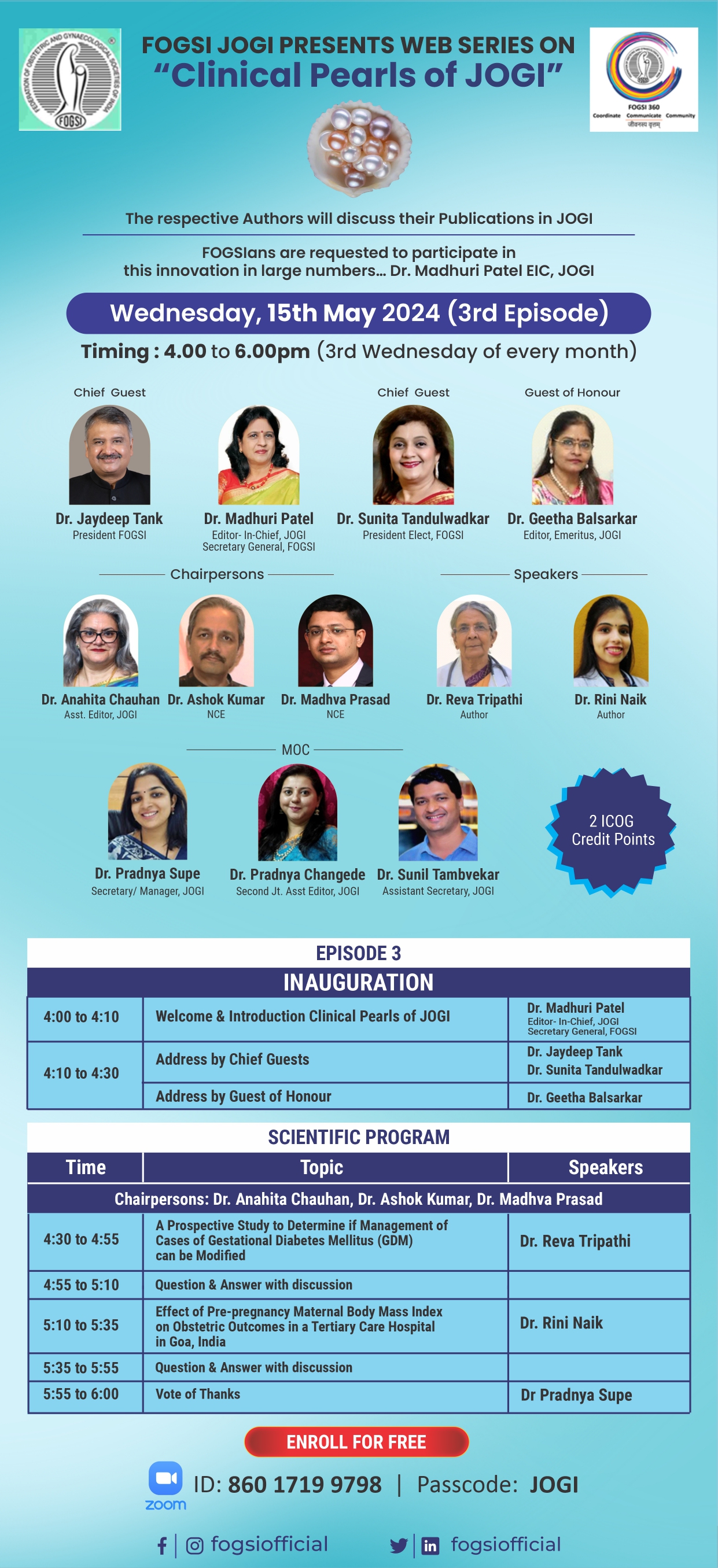
Dr. Pradnya Changede is currently working as an Assistant Professor in the Department of Obstetrics and Gynecology at Lokmanya Tilak Municipal Medical College and General Hospital. She has passed her M.S. (OBGY) from the prestigious Seth GS Medical College and KEM Hospital. She has worked as an Assistant Professor in the Department of Obstetrics and Gynecology at Seth GS Medical College and KEM Hospital. She is a MUHS-recognized postgraduate and undergraduate teacher since 11 years. At present, she is working as Secretary and Manager, Journal of Obstetrics and Gynecology of India. She is an active member of youth council of Mumbai Obstetrics and Gynecology Society. She is a recipient of WONDER FOGSIAN award and has several prizes and publications to her credit. Her fields of interest are high-risk Obstetrics and laparoscopy.
Introduction : Stillbirth is a global health problem having many emotional, social and economic consequences. India has the largest number of stillbirths per year in the world. Objective The objective of this study is to review the causes of stillbirth and classify the causes into maternal, foetal and placental causes and further classify causes by relevant condition at death (ReCoDe) classification. We intend to observe the causes of and demographic factors contributing to the burden of stillbirths. Using this data, the areas of action can be identified and measures can be formulated to reduce a significant number of perinatal mortalities.
Methodology : This is an observational study of data collected over one year (January 2019–December 2019) from a tertiary care centre in Mumbai, India. The maternal demographic characteristics and causes of stillbirth were studied. The causes of stillbirths were classified into maternal, foetal and placental causes and relevant condition at death (ReCoDe) classification [1].
Results : A total of 9074 babies were delivered during this period. There were 275 stillbirths in this year (SBR 30.3 per 1000 total births). Majority of the mothers were in the age group of 26–30 years (32.7%). Almost all the mothers (98.5%) were from urban areas. As per the modified Kuppuswamy classification for urban India, 195 (71.79%) belonged to the upper lower class. 31.2% were primigravidae, and 54.8% had 3 or more antenatal visits. Maternal conditions (pre-eclampsia, diabetes, pre-existing medical disorders) as a group were the cause of maximum number (42%) of stillbirths either directly or as a contributory risk factor. 78% of the stillbirths occurred in the antepartum period. Ours being a referral centre, 65% subjects in the study were referred to us from other peripheral hospitals. 53.8% of the stillborn babies were male. 58.9% were macerated stillbirths. According to the ReCoDe classification, hypertensive disease in pregnancy was the most common cause of stillbirths (76) followed by foetal growth restriction (30).
Conclusion : Most of the stillbirths in this study were due to maternal medical conditions. Out of these conditions, hypertensive disorders of pregnancy and its consequences were the most common (66.08%). Better regulation of the private healthcare sector, provision of healthcare providers and better equipments in peripheral health centres and a well-chalked out referral system will contribute to reduction in the number of preventable stillbirths. Regular facility-based stillbirth review meetings and healthcare provider accountability would also help to reduce the burden of this silent epidemic as well as reach the goal of a “single-digit” stillbirth rate by the year 2030.
Keywords : Stillbirth · Classification of stillbirth · ReCoDe classification
The annual estimated rate of stillbirth worldwide is 2.6 million per year [2]. Low- and middle-income countries contribute to 98% of these stillbirths, thus coming to be known as the “silent epidemic” in these countries. In addition to this, the bereavement care in these countries is often neglected. Focussed interventions are needed to reduce this burden of stillbirth. Indeed, one of the first steps towards targeted interventions is the complete reporting of data regarding where (healthcare facility or the community), when (antepartum or intrapartum) and why (causes, risk factors and contributing factors) due to which the stillbirth occurred.
The health status of a population can be assessed by the stillbirth rate. It truly reflects the quality of antenatal and intrapartum care received by women in the community. India’s stillbirth rate as estimated by WHO is 22 per 1000 total births. It ranks highest in the world in terms of absolute number of stillbirths [3]. The need to improve pregnancy care and to promote institutional deliveries in high-risk groups has been recognised by the Government of India. One of the goals of the “India Newborn Action Plan” is to ‘reduce stillbirths to < 10 per 1000 births by 2030’.
Aims and Objectives
The objective of this study is to review the causes of stillbirth and classify the causes into maternal, foetal, placental causes and by ReCoDe classification system [1]. We intend to observe the causes of and demographic factors contributing to the burden of stillbirths. Using this data, the areas of action can be identified and measures can be formulated to reduce a significant number of perinatal mortalities. This study aims to determine the causes and contributing factors in the occurrence of stillbirths over a period of one year in a tertiary care centre in central Mumbai, India. By knowing these factors, the designing of a prevention strategy will be facilitated.
This is an observational study conducted at a tertiary care centre in Mumbai, India. The definition of stillbirth used was baby born with no signs of life at or after 20 weeks gestation or more than 500 g weight (CDC definition of stillbirth). WHO definition for international comparison is a baby born with no signs of life at or after 28 weeks gestation.
All the stillbirths occurring in the period from 1 January 2019 to 31 December 2019 were included in the study. Our study was conducted over a period of one year (1 January 2019–31 December 2019), taking into account all the stillbirths occurring during this period. The patients who were admitted in the antenatal ward either in emergency or from the outpatient department were interviewed for a detailed history, demographic details and obstetric history was noted. The labour management details were recorded. Data was collected from the patients at the time of admission by history taking and scrutinising antenatal records and transfer summary (if any) at the time of admission and during hospital stay. After the birth of the still born, it was examined externally to look for evidences of maceration and was then classified as a macerated or a fresh stillbirth. Gender of the baby, birth weight and gestational age were recorded in a standard format (Figs. 1, 2). A probable cause of death was assigned. All these data were reviewed with a panel of experts from the Obstetrics-Gynaecology and Neonatology departments in our hospital. Lapses in care, if any, were noted down, and the healthcare workers were given suggestions to prevent the occurence of stillbirths. Following details were collected—maternal demographic details (age, place of residence, socioeconomic status, education), obstetric history (parity, place of antenatal care registration, number of antenatal visits, history of any prior pregnancy losses) and probable cause and time of stillbirth (antenatal or intrapartum). The most relevant condition at death was taken into account in cases where the cause was multifactorial. The data was collected and tabulated.
Salient features of the study: this is an observational study of data collected over one year (January 2019–December 2019) in a tertiary care Hospital in Mumbai. A total of 9074 babies were delivered during this period. There were a total of 275 stillbirths in this year (SBR 30.3 per 1000 total births). As there were three pairs of stillborn twins, hence, demographic data of 272 mothers have been analysed.
Demographic details (Table 1): when the age distribution of mothers who delivered stillborn babies were studied it was noted that 128 subjects (47%) were in the age group of 18–25 years. 89 subjects were in the age group 26–30 years. The number of subjects in the age groups 31–35 years and more than 35 years were 40 and 15, respectively. When we studied the place of residence, it was noted that 268 out of 272 subjects resided in urban areas. Out of these 268 subjects from urban areas, 212 were slum dwellers. All the 4 subjects from rural areas were referred to our centre along the referral linkage system.
When we studied educational qualifications of mothers, we noted that 97 subjects (35.66%) were illiterate, 13 (4.77%) were school dropouts before class 3. 83 subjects (30.52%) had completed primary education and 53 subjects (19.48%) had completed secondary education. 19 study subjects (6.99%) had completed higher secondary education (up to class 12) and 7 subjects (2.58%) had graduate degrees.


As per the modified Kuppuswamy classification for urban India, six mothers (2.19%) belonged to the lower class, 195 (71.79%) belonged to the upper lower class, 68 (24.9%) to the lower middle class and three (1.09%) belonged to upper middle class. 31.2% were primigravidae and 54.8% had 3 or more antenatal visits.
Obstetric History (Table 2) The obstetric data were broadly divided into gravida status, antenatal registration and visits and previous pregnancy loss.
Out of the total 272 subjects, 85 were primigravida. 70 subjects were in their second pregnancy at the time of this study, 66 and 37 patients were in their third and fourth pregnancies, respectively. 14 patients were gravida 5 and above.
Seventy-three subjects (26.8%) were registered at our centre for antenatal care. One hundred and seventy-seven subjects (65.07%) were referred to us from other centres for various reasons. There were 22 subjects (8%) who were unregistered and unimmunised in the current pregnancy. 123 subjects (45 %) had less than 3 antenatal visits throughout the course of the current pregnancy. The remaining 149 subjects (55%) had the recommended 3 or more antenatal outpatient visits.
Fifty-five patients (20.22%) had history of previous pregnancy loss. 0.3 (1.1%) of the study subjects had previous late neonatal deaths. 45 subjects (16.5%) had a stillbirth of > 28 weeks gestation in the past. Five subjects had one or more first-trimester losses, and two subjects had both—a first-trimester pregnancy loss and a stillbirth, respectively.
Baby details (Table 3)

Out of the 275 still-born babies, 148 were male, and 125 were females. There were two babies with ambiguous genitalia. Among the stillbirths, 162 were macerated stillbirths, and 113 were fresh stillbirths. Of 275 stillbirths we noted that 70 [26%] babies weighed in between 1000 and 1499 g. 64 babies [23%] weighed less than 999 g. 49 babies [18%] and 48 babies [17%] weighed between 1500 and 1999 g and 2000 and 2499 g, respectively. 21 babies [8%] weighed between 2500 and 2999 g. 14 babies [5%] and 8 babies [3%] weighed between 3000 and 3499 g and 3500 and 3999 g, respectively.
Probable cause and time of stillbirth is as follows (Figs. 3, 4, 5, 6, 7, 8) Out of total 275 stillborn babies, 61 [22%] had loss of foetal heart sounds (FHS) during labour (intrapartum). 57 of these mothers were referred to our centre in labour, and one of the contributing factors to the stillbirth was a delay in referral to a tertiary centre. There was a considerable overlap in causes of stillbirth in this study. The single most significant contributory factor has been taken into account in this study. 115 stillbirths [42%] were attributable to maternal causes, 84 cases [31%] to foetal causes and 56 cases [20%] were attributable to placental, cord and liquor abnormalities.
Out of 115 maternal causes in 76 subjects, the stillbirth could be attributed to hypertensive disorders of pregnancy and its consequences, 34 cases to other medical disorders and there were 5 miscellaneous causes (Figs. 3, 4, 5, 6). 34 mothers had severe pre-existing medical conditions, and there were 4 maternal mortalities among this group.
Diabetes was seen in 11 mothers of stillborn babies as the primary contributing factor. Severe anaemia was seen in four mothers in this group. There was no maternal mortality among the anaemic mothers. There were 84 cases [31%] attributable to foetal causes (Fig. 7). Prematurity as a cause of stillbirths was seen in 11 cases. 25 still-born babies had structural malformations that were not compatible with life. There was one abdominal pregnancy and two cases of twin-to-twin transfusion syndrome. 18 subjects showed evidence of meconium aspiration in the babies. 56 cases [20%] were attributable to placental, cord and liquor abnormalities (Fig. 8). In 20 cases, no particular cause of stillbirth could be identified. The causes have been tabulated in the ReCoDe system (Table 4). According to the ReCoDe classification, hypertensive disease in pregnancy was the most common cause of stillbirths (76) followed by foetal growth restriction (30).
Globally, India ranks first in the absolute number of stillbirths [3]. 98% of the last trimester stillbirths occur in lowand middle-income countries. For the planning of effective prevention programmes at the national and international level, the proper reporting and analysis of data from these countries are essential. This study aims to determine the causes and contributing factors in the occurrence of stillbirths over a period of one year in a tertiary care centre in central Mumbai, India. By knowing these factors, the designing of a prevention strategy will be facilitated.
The stillbirth rate calculated for this period in our centre was 30.3 per 1000 total births. Out of the 275 stillborn babies, 148 were male, and 125 were females. There were two babies with ambiguous genitalia. Among the stillbirths, 162 were macerated stillbirths, and 113 were fresh stillbirths. In a study conducted in Chandigarh [4] by Newtonraj et al. to identify causes and risk factors leading to stillbirths, it was found that there were 68% antepartum and 32% intrapartum causes of stillbirth. In our study also, 77.8% had an antenatal cause of stillbirth and 22.2% had an intrapartum cause. The observed stillbirth rate in the study conducted in Chandigarh [4] by Newtonraj et al. was 16/1000 births. 60% stillbirths had an intrapartum cause (fresh stillbirths), and 40% stillbirths had an antepartum cause (macerated) in a study conducted by B Sharma et al. [5]. They noted that in the decade from 2007 to 2016, SBR ranged from 62.4 to 73.6/1000 total births. The average SBR in their study was 67.9/1000 births.
In sub-Saharan Africa, 1563 stillbirths were studied by Mamuda Aminu et al. They observed a stillbirth rate of 118.1 in Sierra Leone, 38.8 in Kenya, 34.7 in Zimbabwe and 20.3 in Malawi per 1000 births. 50.7% of all stillbirths in this study had an intrapartum cause [6]. Different states in India show a wide variation in their stillbirth rates [3, 7–13]. By the year 2030, the India Newborn Action Plan aims to end preventable neonatal deaths and stillbirths. Surveillance system of each state can provide better information so that better prevention programmes can be formulated.
A prospective study using “verbal autopsy” [11] to classify causes of stillbirths and early neonatal deaths was conducted in an urban slum settlement in Mumbai over a period of two years. They found that overall, the maximum delays were said to be after arriving at the health facility. These delays were resulting from referral from one institution to another. They were also attributed to a delay at the patient or caregiver level in failure to recognise symptoms or their severity. In this study, it was concluded that clear protocols are needed for transfer at each level. Rapid identification of health problems and proper communication between the health care facilities was also emphasised. In our study, 73 subjects (26.8%) were registered at our centre for antenatal care. 177 subjects (65.07%) were referred to us from other centres for various reasons. There were 22 subjects (8%) who were unregistered and unimmunised in the current pregnancy. 45% (123 subjects) had less than 3 antenatal visits in the current pregnancy. The remaining 149 subjects (55%) had the recommended 3 or more antenatal outpatient visits. In our study, out of the total 272 subjects, 85 were primigravida. 70 subjects were in their second pregnancy at the time of this study, 66 and 37 patients were in their third and fourth pregnancies, respectively. 14 patients were gravida 5 and above.
Sharma et al. observed that out of 51,552 total births in their study, 29,149 women (56%) were booked, and the rest were unbooked or inadequately booked with fewer than four antenatal visits. Most of these mothers were referrals and unbooked cases (83.9%) had no foetal heart sounds on admission. Of the unbooked cases, 13.8% women delivered stillborn babies, whereas the rate in booked cases was 2% [5].
In our study out of total 275 stillborn babies, 61 [22%] had loss of foetal heart sounds (FHS) during labour (intrapartum). 57 of these mothers were referred to our centre in labour, and one of the contributing factors to the stillbirth was a delay in referral to a tertiary centre. There was a considerable overlap in causes of stillbirth in this study. The single most significant contributory factor has been taken into account in this study. 115 stillbirths [42%] were attributable to maternal causes, 84 cases [31%] to foetal causes, and 56 cases [20%] were attributable to placental, cord and liquor abnormalities.


Out of 115 maternal causes in 76 subjects, the stillbirth could be attributed to hypertensive disorders of pregnancy and its consequences (19 cases with severe pre-eclampsia, 18 cases with abruptio placentae, 11 had intrauterine growth restriction and Doppler changes suggestive of fetoplacental insufficiency). There were eight patients with HELLP syndrome and abruptio placenta and eight cases with pre-eclampsia and associated diabetes mellitus. Eclampsia was noted in five cases. Cardiac disease with superimposed pre-eclampsia was seen in two mothers. Chronic hypertension with superimposed pre-eclampsia was present in two cases. There was one case each of chronic hypertension with abruptio placenta, pre-eclampsia with cholestasis and pre-eclampsia with anaemia and MODS, 34 cases were attributable to other medical disorders, and there were five miscellaneous causes (Figs. 3, 4, 5, 6). 34 mothers had severe pre-existing medical conditions, and there were 4 maternal mortalities among this group. The medical disorders were as follows: diabetes was seen in 11 mothers of stillborn babies as the primary contributing factor. Severe anaemia was seen in four mothers of this group. There was no maternal mortality among the anaemic mothers. Five mothers had fever preceding the stillbirth, three cases had hepatic, renal and cardiac diseases (total 9). There was one case each of maternal dengue, altered sensorium and malignant common bile duct stricture. There were 84 cases [31%] attributable to foetal causes (Fig. 7). Prematurity as a cause of stillbirths was seen in 11 cases. 25 still-born babies had structural malformations that were not compatible with life. 30 foetuses had foetal growth restriction. Seven babies had evidence of foetal distress. Six mothers claimed perceiving decreased foetal movements prior to labour. There were three cases of hydrops foetalis and two cases of Rh isoimmunisation. There was one abdominal pregnancy and two cases of twin-to-twin transfusion syndrome. 18 subjects showed evidence of meconium aspiration in the babies. 56 cases [20%] were attributable to placental, cord and liquor abnormalities (Fig. 8). Among these, the maximum cases were of abruptio placentae and meconium-stained amniotic fluid (20 and 18, respectively). Six patients had polyhydramnios with preterm premature rupture of membranes (PPROM). There were a total of six cases of placenta previa, three of which had associated abruptio placentae. Two patients had prolapse of the umbilical cord. One patient had severe oligohydramnios as the contributory cause for stillbirth. In 20 cases, no particular cause of stillbirth could be identified. Mamuda Aminu et al. observed that in sub-Saharan Africa the cause of deaths included: asphyxia (18.5–37.4%), placental disorders (8.4–15.1%), maternal hypertensive disorders (5.1–13.6%), infections (4.3–9.0%), cord problems (3.3–6.5%), and ruptured uterus due to obstructed labour (2.6–6.1%). The cause was unknown in 17.9–26.0% of cases [6]. In a study done in Chandigarh, antepartum causes were more common (68%) than intrapartum causes (32%) [4]. Among maternal conditions, hypertension (18.2%) and chorioamnionitis (13.8%), and among foetal conditions, growth restriction (19.9%) and congenital anomalies (18.8%) were the leading causes. In about half of the stillbirths foetal (48%) and maternal (44.7%) causes were unidentifiable. Risk factors for stillbirths were: higher maternal age (aOR 1.1, 95%CI 1.0–1.2), vaginal delivery (aOR 8.1, 95%CI 2.6–26), induced labour (aOR 2.6, 95%CI 1.5–4.5), green or light brown liquor (aOR 2.0, 95%CI 1.1–3.8), preterm delivery (aOR 6.4, 95%CI 3.7–11) and smaller household size (aOR 1.2, 95% CI 1.1–1.3) [6]. A Southern Indian study by Kallur Sailaja Devi classified the causes of stillbirth by Recode classification. Foetal growth disorders were the leading cause of death in 123(28.2%) followed by hypertensive disorders in pregnancy in 67(15.3%) and unexplained stillbirths in 56(12.8%) which is similar to our study [14].

In our study, according to the ReCoDe classification, hypertensive disease in pregnancy was the most common cause of stillbirth (76) followed by foetal growth restriction (30).
Conflict of interest All authors declare that they have no conflict of interest.
Ethical Approval Taken from institutional ethics committee.
Human Rights Study has been approved by institutional ethics board, and all procedures performed in study involving human participants were in accordance with the ethical standards of the institution and with the 1964 Helsinki declaration and its later amendments or comparable ethical standards.
Informed Consent Informed consent has been obtained from all participants of this study.
1. Gardosi J, Kady SM, McGeown P, et al. Classification of stillbirth by relevant condition at death (ReCoDe): population based cohort study. BMJ. 2005;331:1113.
2. Lawn JE, Blencowe H, Waiswa P, et al. Stillbirths: rates, risk factors, and acceleration towards 2030. Lancet. 2016;387:587–603.
3. Blencowe H, Cousens S, Jassir FB, et al. National, regional, and worldwide estimates of stillbirth rates in 2015, with trends from 2000: a systematic analysis. Lancet Glob Health. 2016;4:e98–108. https:// doi. org/ 10. 1016/ S2214- 109X(15) 00275-2.
4. Newtonraj A, Kaur M, Gupta M, et al. Level, causes, and risk factors of stillbirth: a population-based case control study from Chandigarh, India. BMC Pregnancy Childbirth. 2017;17(1):371. https:// doi. org/ 10. 1186/ s12884- 017- 1557-4.
5. Sharma B, Prasad GRV, Aggarwal N, et al. Aetiology and trends of rates of stillbirth in a tertiary care hospital in the north of India over 10 years: a retrospective study. BJOG. 2019;126(S4):14–20.
6. Aminu M, Bar-Zeev S, White S, et al. Understanding cause of stillbirth: a prospective observational multi-country study from sub-Saharan Africa. BMC Pregnancy Childbirth. 2019;19:470. https:// doi. org/ 10. 1186/ s12884- 019- 2626-7.
7. Lawn JE, Blencowe H, Pattinson R, et al. Stillbirths: Where? When? Why? How to make the data count? Lancet. 2011;377(9775):1448–63.
8. SRS statistical report 2013. Ministry of Home affairs, government of India.
9. Doke PP, Karantaki MV, Deshpande SR. Adverse pregnancy outcomes in rural Maharashtra, India (2008–09): a retrospective cohort study. BMC Public Health. 2012;12:543. https:// doi. org/ 10. 1186/ 1471- 2458- 12- 543.
10. More NS, Bapat U, Das S, et al. Community mobilization in Mumbai slums to improve perinatal care and outcomes: a cluster randomized controlled trial. PLoS Med. 2012;9(7): e1001257. https:// doi. org/ 10. 1371/ journ al. pmed. 10012 57.
11. Mony PK, Varghese B, Thomas T. Estimation of perinatal mortality rate for institutional births in Rajasthan state, India, using capture-recapture technique. BMJ Open. 2015;5(3): e005966. https:// doi. org/ 10. 1136/ bmjop en- 2014- 005966.
12. Kochar PS, Dandona R, Kumar GA, et al. Population-based estimates of still birth, induced abortion and miscarriage in the Indian state of Bihar. BMC Pregnancy Childbirth. 2014;14:413. https:// doi. org/ 10. 1186/ s12884- 014- 0413.
13. Bapat U, Alcock G, More NS, et al. Stillbirths and newborn deaths in slum settlements in Mumbai, India: a prospective verbal autopsy study. BMC Pregnancy Childbirth. 2012;12:39. https:// doi. org/ 10. 1186/ 1471- 2393- 12- 39.
14. Devi KS, Aziz N, Gala A, et al. Incidence of stillbirths and risk factors at a tertiary perinatal center in Southern India: retrospective observational study. Int J Gynecol and Reprod Sci. 2018;1(1):14–22.
15. Bhutta ZA, Darmstadt GL, Haws RA, et al. Delivering interventions to reduce the global burden of stillbirths: improving service supply and community demand. BMC Pregnancy Childbirth. 2009;9:S7. https:// doi. org/ 10. 1186/ 1471- 2393-9- S1- S7.
16. https:// www. unicef. org/ repor ts/ ending- preve ntable- newbo rndeaths- still births- quali ty- health- coverage-2020–2025