


The Journal of Obstetrics and Gynaecology of India
did-you-know
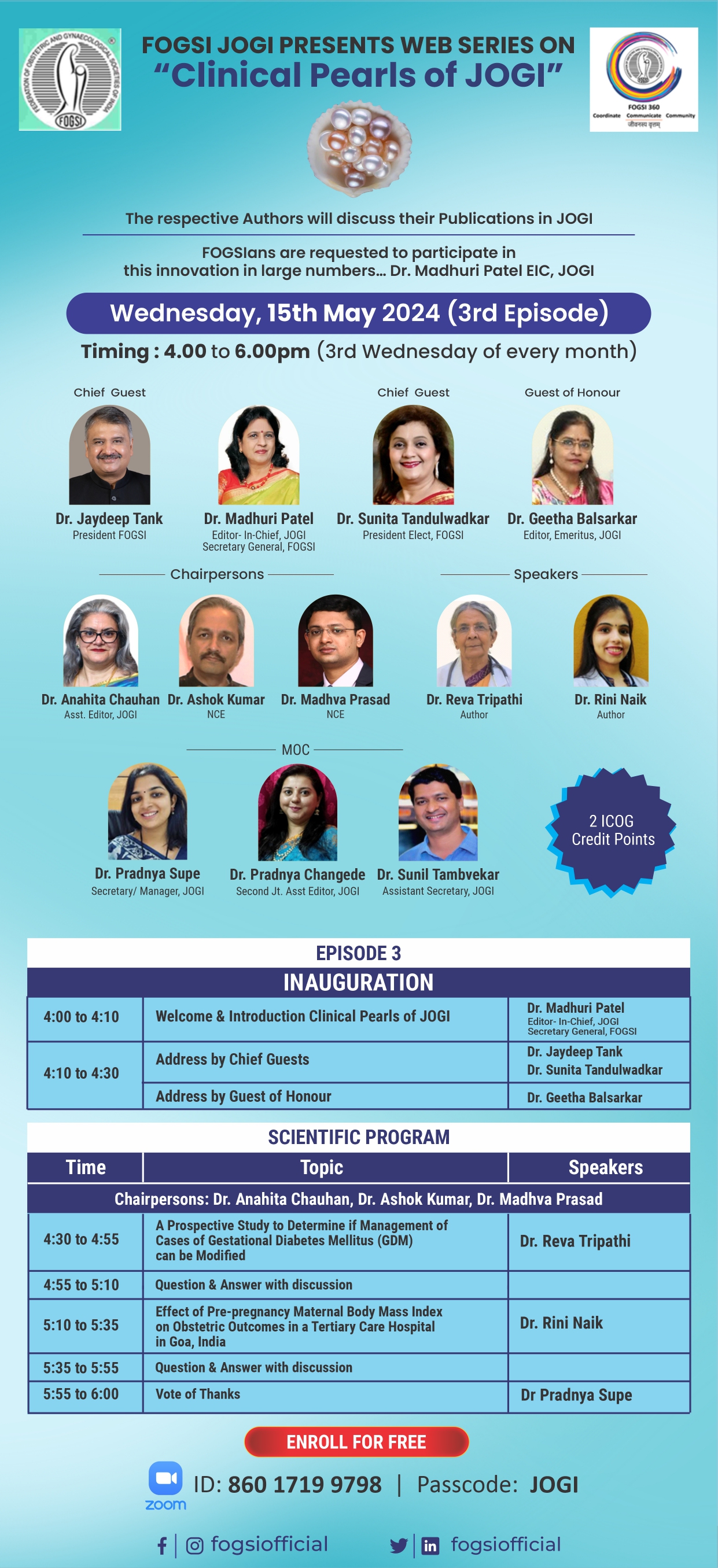
Clinical Pearls of JOGI SERIES OF WEBINARS Click her to view
VOL. 65 NUMBER 5 September-October  2015

Comments on ‘‘Uterine Artery Embolization Following Internal Iliac Arteries Ligation in a Case of Postpartum Hemorrhage: A Technical Challenge’’

Savita Rani Singhal1,3 ● Suresh Kumar Singhal2

Savita Rani Singhal is a Professor in the Department of Obstetrics and Gynaecology, and Suresh Kumar Singhal is a Senior Professor in the Department of Anesthesia, Pt BD Sharma Post-Graduate Institute of Medical Sciences, Rohtak, Haryana, India.

This work described has not been published before; that it is not under consideration for publication anywhere else; that its publication has been approved by all co-authors.

Savita Rani Singhal [savita06@gmail.com]

1 Department of Obstetrics and Gynaecology, Pt BD Sharma, Post Graduate Institute of Medical Sciences, Rohtak, Haryana, India
2 Department of Anesthesia, Pt BD Sharma, Post Graduate Institute of Medical Sciences, Rohtak, Haryana, India
3 H No. 14/8 FM, Medical Campus, Rohtak, Haryana 124001, India

  • Download Article
  • Email Article
  • Print Article
  • Whatsapp Article

Dear Editor,

The article ‘‘Uterine Artery Embolization Following Internal Iliac Arteries Ligation in a Case of Postpartum Hemorrhage: A technical Challenge’’ by Singhal et al. published in MAY–JUNE 2015 issue is highly appreciated. This solitary case report is delivering awakening message for the obstetricians.

Bilateral internal iliac artery ligation (BIIAL) is wellknown life-saving surgical procedure for controlling postpartum hemorrhage. Following BIIAL, uterine arterial pressure drops, and uterine blood supply decreases at a rate of 85 percent which aids in the achievement of hemostasis [1]. BIIAL has success rate of about 80 % [2]. There is not much stated in the literature, of the reason as to why it is not successful in all the cases. In the case report by Singhal et al. [3], the authors were able to do uterine artery embolization (UAE) after BIIAL. They were able to pass Progreat microcatheter through the ligated vessel, which clearly indicates that the ligation of the internal iliac artery was not tight enough and allowed blood flow beyond the ligature, thus resulting in persistent bleeding even after the BIIAL. BIIAL is always an emergency procedure in cases of postpartum hemorrhage, and most of the times, patient condition may not be stable and obstetrician may also be under stress; there may be also some apprehension that too much tightening of ligature may lead to injury to the vessel wall; and thus, the ligature may not be too tight to be effective in controlling postpartum hemorrhage.

This case has created an insight for the obstetricians to be vigilant while tightening the internal iliac artery that ligature should be tight enough to prevent blood flow distal to the ligature, so that success rate of BIIAL is increased.
References

  1. Fatu C, Puisoru M, Fatu CI. Morphometry of internal iliac artery in different ethnic groups. Ann Anat. 1996;188:541–6.
  2. Yavz S, Ercan Y, Ebru C, et al. Efficacy of internal iliac artery ligation on management of postpartum hemorrhage and its impact on the ovarian reserve. J Turk Soc Obstet Gynecol. 2012;9(3): 153–8.
  3. Singhal M, Gupta P, Sikka P, et al. Uterine artery embolization following internal iliac arteries ligation in a case of postpartum hemorrhage: a technical challenge. J Obstet Gynaecol India. 2015;65(3):202–5.
  • Download Aarticle
  • Email Aarticle
  • Print Article
  • Whatsapp Article